How to Build a Business System That Works on Low-Energy Days
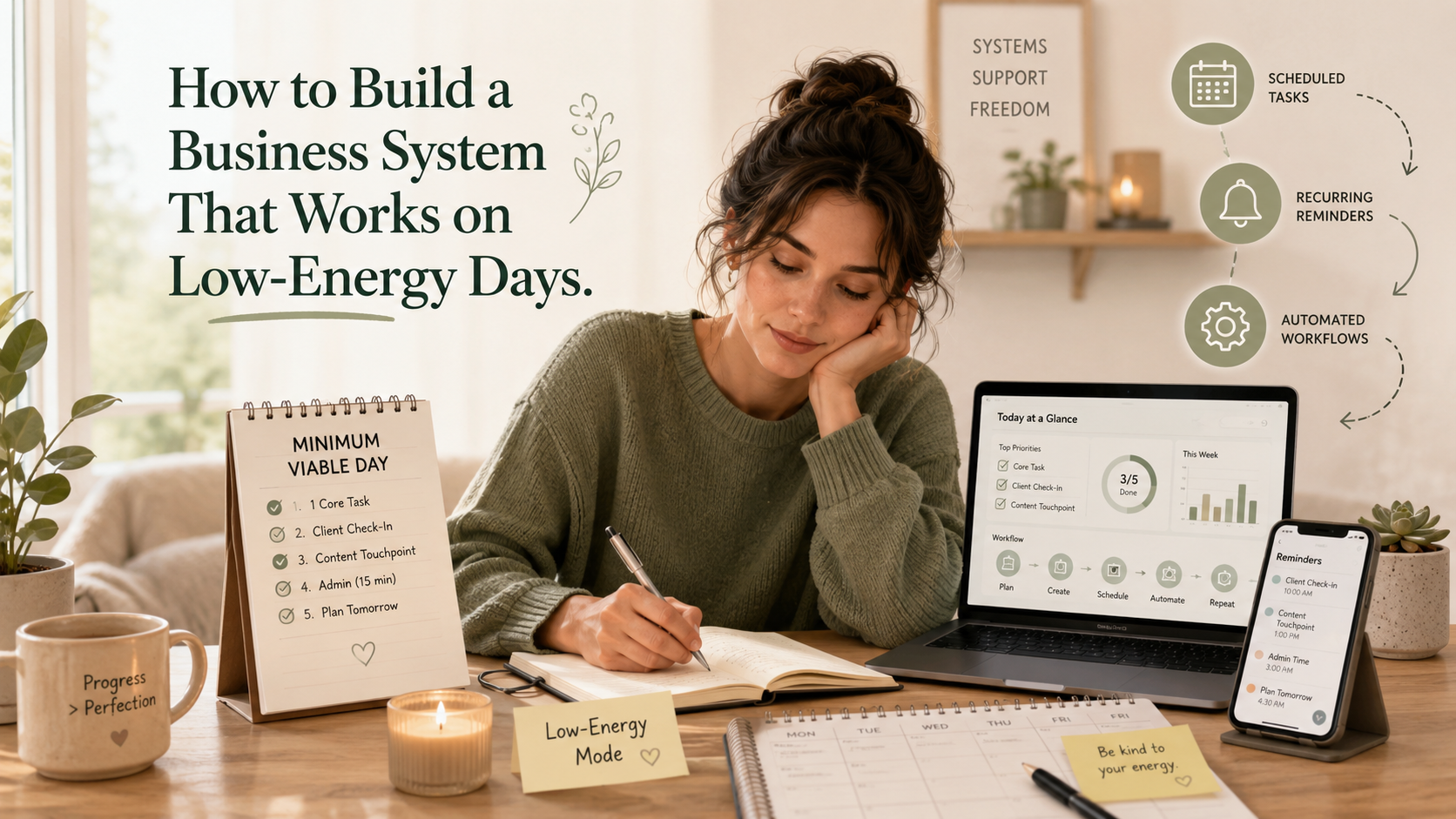
Running a business as a solopreneur with ADHD can feel like juggling flaming swords while riding a bike with no handlebars.
Some days, you’re full of ideas, momentum, and big “let’s do this” energy.
Other days?
Opening your laptop feels like climbing a mountain.
You know what needs to get done. You may even have a beautiful planner, a project management app, and a color-coded calendar staring back at you. But when your energy drops, your brain says, “Nope. Not today.”
That does not mean you are lazy.
It does not mean you are bad at business.
And it definitely does not mean you are failing.
It means your business needs systems that work with your brain, not against it.
For ADHD solopreneurs, low-energy days are not rare interruptions. They are part of the rhythm. Executive function, dopamine regulation, sensory load, decision fatigue, and emotional overwhelm can all affect how much capacity you have on any given day.
That is why you need a Low-Energy Mode for your business.
Not a hustle-harder plan.
Not a 17-step productivity routine.
A simple, low-friction system that helps you keep the business moving, even when your brain and body are running on 12%.
Why Low-Energy Days Hit ADHD Solopreneurs So Hard

Low-energy days can feel especially frustrating when you have ADHD because your ability to work is not always tied to how much you care.
You can love your business and still avoid your inbox.
You can want more clients and still struggle to follow up.
You can have a deadline and still feel frozen.
That is the tricky part of ADHD productivity. Motivation, urgency, interest, novelty, and emotional state often play a major role in whether a task feels doable.
Traditional business advice tends to assume that if something matters, you will simply do it.
But ADHD brains do not always work that way.
Traditional Productivity Systems Often Fail Because They Require Too Much Activation Energy
Many productivity systems are built around consistency, discipline, and long-term planning.
That sounds nice on paper.
But on a low-energy day, those systems can fall apart because they ask you to:
- Make too many decisions
- Prioritize from scratch
- Switch between tasks quickly
- Remember hidden steps
- Start tasks without immediate reward
- Follow a routine that depends on high executive function
For an ADHD solopreneur, that is a lot.
When your brain is already tired, even tiny tasks can feel huge. Something as simple as “send the invoice” may actually involve several invisible steps:
- Find the client details
- Open the invoicing tool
- Check the project amount
- Write the message
- Attach the invoice
- Worry about sounding awkward
- Hit send
- Track whether it was paid
That is not one task.
That is a whole obstacle course.
The ADHD Connection: Executive Function, Dopamine, and Energy Fluctuations
To build better business systems, it helps to understand why low-energy days happen.
ADHD is often linked to challenges with executive function, which includes the mental skills needed to plan, organize, prioritize, start tasks, manage time, and regulate emotions.
So when your energy dips, your executive function may dip too.
That can make everyday business tasks feel harder than they “should.”
Executive Dysfunction Can Make Simple Tasks Feel Impossible
Executive dysfunction is not a character flaw. It is a brain-based difficulty with turning intention into action.
You may experience it as:
- Staring at a task but not starting
- Feeling overwhelmed by where to begin
- Avoiding tasks with too many steps
- Forgetting important follow-ups
- Struggling to switch from one task to another
- Feeling emotionally flooded by admin work
This is why “just make a to-do list” is not always helpful.
A to-do list tells you what exists.
It does not always help you start.
Dopamine Regulation Affects Motivation
ADHD brains often seek interest, novelty, urgency, or reward. That is why you may suddenly deep-clean your website at midnight but avoid a simple client email all afternoon.
Your brain is not being dramatic.
It is looking for enough dopamine to get moving.
This is also why boring-but-important business tasks can be so difficult, including:
- Bookkeeping
- Scheduling
- Inbox management
- CRM updates
- Filing receipts
- Sending reminders
- Creating recurring content
These tasks matter. They are just not naturally stimulating.
That is where business automation and low-friction systems can be game changers.
What Is a Low-Energy Business System?

A low-energy business system is a simplified way of running your business when your capacity is limited.
Think of it as a backup mode.
Your regular business system may include content creation, client work, marketing, admin, networking, and strategy.
Your Low-Energy Mode asks a different question:
What is the smallest version of today that keeps my business safe, stable, and moving?
That is it.
No guilt.
No overhauling your life.
No pretending you have unlimited energy.
A low-energy business system helps you:
- Reduce decision fatigue
- Avoid business bottlenecks
- Protect client trust
- Keep cash flow moving
- Prevent missed deadlines
- Create a sense of control
- Make progress without burning out
Build Your Business “Low-Energy Mode”
Your Low-Energy Mode is not a failure plan.
It is a support plan.
The goal is to decide ahead of time what matters most when your capacity is low. That way, you are not trying to build the parachute while falling out of the plane.

Step 1: Identify Your Business-Critical Tasks
Not every task deserves your low-energy attention.
On hard days, your goal is not to be impressive. Your goal is to keep the business functioning.
Start by asking:
What would create a real problem if I ignored it today?
For most solopreneurs, business-critical tasks include:
- Responding to urgent client messages
- Completing deadline-sensitive client work
- Sending invoices
- Checking payment issues
- Confirming appointments
- Handling anything legally or financially important
Tasks that can usually wait include:
- Redesigning your website
- Posting on every social platform
- Rewriting your bio again
- Watching another productivity video
- Reorganizing your Notion dashboard
- Creating a new offer from scratch
Be honest with yourself.
Some tasks feel urgent because they are emotionally loud. That does not mean they are actually urgent.
Step 2: Create a Minimum Viable Day Checklist
A minimum viable day checklist is one of the most useful ADHD productivity tools for business owners.
It is a short list of tasks that count as “enough” on a low-energy day.
Not your ideal day.
Not your most productive day.
Your enough day.
Here is an example:
Minimum Viable Day Checklist for ADHD Solopreneurs
- Check messages for urgent client needs
- Complete or move forward one revenue-related task
- Send any invoice, payment link, or reminder that is due
- Review today’s calendar
- Choose one tiny task that helps future-you
- Stop before total burnout
That is it.
This checklist should be so simple that you can complete it even when your brain feels foggy.
H3: Make the Checklist Visible
Do not bury your minimum viable day checklist inside an app you forget to open.
Put it somewhere obvious:
- On a sticky note near your desk
- As your phone lock screen
- Inside your planner
- At the top of your project management tool
- In a pinned note
- On a whiteboard
ADHD brains often benefit from external reminders. Out of sight really can become out of mind.
So make the system easy to see.
Step 3: Sort Tasks by Energy Level
Most to-do lists are not ADHD-friendly because they treat every task the same.
But “write a sales page” and “reply yes to an email” do not require the same energy.
Instead, sort your tasks into energy categories.
High-Energy Tasks
These require focus, creativity, or complex thinking:
- Writing long-form content
- Recording videos
- Creating offers
- Building strategy
- Hosting sales calls
- Doing deep client work
- Making major decisions
Medium-Energy Tasks
These require some focus but are more contained:
- Editing content
- Scheduling posts
- Updating a project board
- Sending follow-up emails
- Reviewing client notes
- Creating a simple outline
Low-Energy Tasks
These are simple, repetitive, or easy to start:
- Sending a template email
- Checking payment status
- Dragging tasks into tomorrow
- Filing receipts
- Renaming documents
- Scheduling a prewritten post
- Updating one client status
On low-energy days, stop trying to force high-energy work.
Choose from the low-energy list instead.
That is not avoidance. That is smart business design.
Step 4: Build Low-Friction Systems
A low-friction system makes the next step obvious.
It removes unnecessary thinking, clicking, searching, and deciding.
For ADHD solopreneurs, this matters because every extra step can become a dropout point.
Use Templates for Repeated Communication
Templates are your friend.
They reduce the emotional and cognitive load of writing the same message over and over.
Create templates for:
- Client onboarding
- Inquiry responses
- Follow-ups
- Invoice reminders
- Project updates
- Appointment confirmations
- Late payment notices
- Testimonial requests
For example:
Subject: Quick follow-up
Hi [Name],
Just checking in on this. No rush if you are still reviewing, but I wanted to bring it back to the top of your inbox.
Thanks,
[Your Name]
Simple. Clear. Done.
You do not need to reinvent the wheel every time.
Create “Done Enough” Standards
Perfectionism and ADHD can be a brutal combo.
You may avoid finishing something because it does not feel polished enough.
So create “done enough” standards before you start.
For example:
A blog post is done enough when:
- It answers the main question
- It has clear headings
- It includes a call to action
- It has been checked once for obvious errors
- It is published or scheduled
A client update is done enough when:
- It says what was completed
- It says what happens next
- It includes any question you need answered
A social post is done enough when:
- It shares one useful idea
- It has a simple caption
- It includes a next step
Done enough keeps your business moving.
Perfect keeps your business waiting.
Step 5: Automate the Tasks That Drain You

Business automation is not about becoming robotic.
It is about protecting your energy.
When you have ADHD, automation can reduce the number of tasks your brain has to remember, initiate, and repeat.
That is huge.
Best Areas to Automate in a Solopreneur Business
Start with the tasks that are boring, repetitive, or easy to forget.
Good candidates for automation include:
- Appointment scheduling
- Invoice reminders
- Payment confirmations
- Email welcome sequences
- Client onboarding forms
- Social media scheduling
- Lead capture
- Recurring task reminders
- File organization
- Follow-up emails
You do not need a complicated tech stack.
In fact, please do not build one just to feel productive.
The best ADHD-friendly automation is simple, reliable, and easy to maintain.
Practical Tools for ADHD-Friendly Business Automation
Here are a few types of tools that can help simplify your workflow.
Scheduling Tools
Use scheduling tools to avoid back-and-forth emails.
Helpful for:
- Discovery calls
- Client check-ins
- Consultations
- Podcast interviews
- Project reviews
Look for features like:
- Calendar syncing
- Automatic reminders
- Buffer time between meetings
- Daily booking limits
For ADHD brains, buffer time is not a luxury. It is a regulation tool.
Invoicing and Payment Tools
Use invoicing tools that send automatic reminders.
This helps reduce the awkwardness and memory load around money.
Look for:
- Recurring invoices
- Auto-reminders
- Payment links
- Invoice templates
- Payment tracking
Getting paid should not depend on whether you remembered to follow up during a chaotic week.
Email Templates and Automations
Email can be a major executive function trap.
A simple email system can help you avoid inbox paralysis.
Try creating:
- Canned responses
- Labels or folders
- Auto-replies for inquiry forms
- A weekly inbox reset
- Follow-up reminders
You can also create a “reply later” folder, but be careful. For many ADHD solopreneurs, “later” can become a digital junk drawer.
Set a reminder to review it.
Project Management Tools
A good project management tool should reduce stress, not create more of it.
You may use tools like a simple Kanban board with columns such as:
- To Do
- Doing
- Waiting
- Done
For low-energy days, add a special column called:
Low-Energy Tasks
This gives you a safe place to look when your brain cannot handle the full task list.
Content Scheduling Tools
If marketing drains you, batch content on higher-energy days and schedule it ahead.
This helps your business stay visible even when you need to slow down.
Keep your content system simple:
- One idea bank
- One content template
- One scheduling tool
- One realistic posting rhythm
You do not need to be everywhere.
Consistency is easier when it is sustainable.
Step 6: Design Your “Minimum Viable Marketing” Plan
Marketing can be one of the first things to disappear on low-energy days.
That makes sense. Marketing requires creativity, visibility, decision-making, and emotional resilience.
Whew.
That is a lot.
Instead of expecting yourself to show up at full power all the time, create a minimum viable marketing plan.
What Minimum Viable Marketing Can Look Like
On a low-energy week, your marketing might be:
- Reposting a previous tip
- Sending one helpful email
- Sharing a client win
- Updating one old blog post
- Commenting thoughtfully on three relevant posts
- Recording a quick voice note and turning it into content later
- Sharing a behind-the-scenes lesson
The goal is not maximum visibility.
The goal is staying gently connected.
Create a Reusable Content Bank
A content bank can save you on days when your brain says, “I have no thoughts.”
Add simple prompts like:
- A common mistake my clients make is…
- One thing I wish more people knew about…
- A quick tip for…
- Here is how I handle…
- A reminder you may need today…
- Before you hire someone for this, consider…
- A client asked me this recently…
You can also save:
- Testimonials
- FAQs
- Personal stories
- Quick tips
- Myths
- Screenshots of good questions
- Old posts worth repurposing
Your future low-energy self will thank you.
Step 7: Reduce Decisions Before You Need To
Decision fatigue is a major issue for ADHD solopreneurs.
The more decisions your business requires, the more energy you burn before the real work even starts.
So wherever possible, decide once.
Create Defaults for Common Business Choices
Defaults are pre-decided answers.
Examples:
- Discovery calls only happen on Tuesdays and Thursdays
- Invoices are sent every Friday
- Admin happens for 30 minutes each morning
- Client work starts after checking the calendar
- Social posts use one of three formats
- New leads receive the same intake form
- Low-energy days follow the same checklist
Defaults reduce the need to negotiate with yourself.
And honestly, that is half the battle.
Step 8: Make Starting Easier Than Avoiding
A task that takes five minutes can still feel impossible when the starting point is unclear.
So create “starter steps.”
A starter step is the tiniest possible action that begins the task.
Not finishes it.
Begins it.
Examples of Starter Steps
Instead of “write newsletter,” try:
- Open the draft
- Write one messy sentence
- Choose a subject line later
- Paste in one idea from your notes
Instead of “do bookkeeping,” try:
- Open the finance app
- Upload one receipt
- Categorize one transaction
Instead of “work on client project,” try:
- Open the client folder
- Read the last note
- Set a 10-minute timer
Momentum often comes after starting, not before.
That is why starter steps matter.
Step 9: Add Recovery Into the System
Your business system should not only help you push through low-energy days.
It should also help you recover from them.
Many ADHD solopreneurs accidentally create systems based on shame. They fall behind, panic, overwork, crash, and repeat.
That cycle is exhausting.
A better system includes recovery by design.
Build a Reset Routine
A reset routine helps you return to your business after a rough day without spiraling.
Keep it short.
Try this:
- Check your calendar
- Review deadlines
- Move unfinished tasks
- Send any necessary update
- Choose one priority for the day
- Clear only the workspace you need
Do not start by reviewing every missed task from the past three weeks.
That is a trap.
Start with today.
Use “Communication Bridges”
When you are low-energy, client communication can feel heavy. But silence often creates more stress later.
Create simple communication bridges for moments when you need more time.
Example:
Hi [Name],
I wanted to let you know I am still working on this and will send the next update by [day]. Thanks for your patience.
That tiny message can protect trust without requiring a long explanation.
You do not owe everyone your full nervous system report.
Clear communication is enough.
Step 10: Protect Your Energy Like a Business Asset
Your energy is not separate from your business.
It is part of the business.
As a solopreneur, you are the strategist, service provider, marketer, admin assistant, customer support team, and finance department.
So your capacity matters.
Energy Protection Strategies for ADHD Business Owners
Try building in:
- Buffer time after calls
- No-meeting days
- Shorter work blocks
- Clear stopping points
- Prewritten client boundaries
- Fewer active projects at once
- Simple weekly planning
- Regular admin days
- A shutdown routine
A shutdown routine can be especially helpful because it tells your brain, “We are done for today.”
That can reduce the open-loop feeling that keeps you mentally working long after you have closed the laptop.
Sample Low-Energy Mode Workflow
Here is what a Low-Energy Mode day might look like for an ADHD solopreneur.
Morning
- Check calendar
- Identify anything urgent
- Drink water or eat something simple
- Open minimum viable day checklist
First Work Block
- Complete one client or revenue-related task
- Send any urgent message
- Use templates instead of writing from scratch
Second Work Block
- Choose one low-energy admin task
- Send invoice or follow-up
- Update project board
Wrap-Up
- Move unfinished tasks to another day
- Send any quick status update
- Pick tomorrow’s first task
- Stop working
This is not glamorous.
But it works.
And on low-energy days, working is not about being flashy. It is about staying supported.
Example Minimum Viable Day Checklist
You can copy and adapt this:
My Low-Energy Business Checklist
Today, I only need to:
- Check my calendar for deadlines or calls
- Reply to urgent client messages
- Do one task that protects income
- Send any invoice or payment reminder due today
- Move non-urgent tasks to another day
- Choose one tiny task for future-me
- Close the day without guilt
That last one matters.
No guilt.
Guilt does not make you more productive. It just makes the next task heavier.
ADHD-Friendly Business Automation Ideas
Here are a few simple automation ideas that can lower friction quickly.
Client Inquiry Automation
Set up a form that collects:
- Name
- Business type
- Service needed
- Budget range
- Timeline
- Main challenge
Then send an automatic reply explaining what happens next.
This keeps you from manually answering the same first-step questions again and again.
Appointment Reminder Automation
Use automatic reminders before calls.
This helps both you and your clients.
You can set reminders for:
- 24 hours before
- 1 hour before
- 10 minutes before
For ADHD solopreneurs, reminders are not “extra.” They are infrastructure.
Invoice Reminder Automation
Set up automatic payment reminders so you do not have to remember every due date.
This protects cash flow and reduces emotional stress.
Task Recurrence Automation
Recurring tasks are easy to forget because they do not always feel urgent.
Set recurring reminders for:
- Weekly admin
- Monthly bookkeeping
- Content planning
- Client check-ins
- Software renewals
- Tax prep
- Metrics review
The less your business relies on memory, the better.
Common Mistakes to Avoid
Building ADHD-friendly systems takes experimentation. Still, there are a few traps worth avoiding.
Mistake 1: Building a System That Requires a Perfect Day
Your system should not only work when you are rested, focused, motivated, hydrated, and magically free of interruptions.
That is not a system.
That is a fantasy.
Build for real life.
Mistake 2: Using Too Many Tools
More tools do not always mean more organization.
Sometimes they create more places to lose information.
Choose fewer tools and use them consistently.
A simple system you actually use is better than a beautiful dashboard you avoid.
Mistake 3: Confusing Planning With Progress
Planning can feel productive because it gives a sense of control.
But if you spend all your energy organizing tasks and none doing them, the system is too heavy.
Your system should help you act.
Mistake 4: Expecting the Same Output Every Day
ADHD energy can fluctuate.
Your business system should allow for different levels of capacity.
Some days are for deep work.
Some days are for maintenance.
Some days are for recovery.
All three can belong in a healthy business.
Final Thoughts: Your Business Can Support You Back
You do not need a business that only works when you are at your best.
You need a business that can hold you when you are tired, foggy, overstimulated, under-motivated, or stretched thin.
That is what low-friction systems are for.
That is what automation is for.
That is what a minimum viable day checklist is for.
Not to make you less human.
Not to force you into productivity all the time.
But to create a business that respects your brain, your energy, and your actual life.
As an ADHD solopreneur, you are allowed to build differently.
You are allowed to simplify.
You are allowed to make things easier on purpose.
Start with one tiny system today. Maybe it is an email template. Maybe it is an invoice reminder. Maybe it is a three-item minimum viable day checklist.
Small counts.
Simple counts.
Done enough counts.
And yes, your business can still grow from there.
-
Posted in
ADHD, attention deficit disorder, attention deficit hyperactivity disorder, AuDHD, automation, low-energy, minimally viable system, Tips and Tricks
